
Posted by Editorial Team
on August 26, 2026

Table of Contents
- Why Natural Hair Care Products Outperform Conventional Formulas
- Organic Hair Care Ingredients to Avoid (And What to Use Instead)
- How to Transition to Natural Hair Products Without the Frustration
- Best Natural Hair Care for Eczema and Sensitive Scalps
- Natural Hair Care by Hair Type: Matching the Right Ingredients
- Cruelty-Free, Vegan, and Sustainable Packaging: What the Labels Actually Mean
- How to Verify a Product Is Truly Natural Before You Buy
- Conclusion
Last Updated: August 25, 2026
Most people switching to natural hair care products expect instant results. What they actually get, at least in the first few weeks, is a confusing adjustment period that sends them running back to their old shampoo. This guide from Bellepeau breaks down exactly what to look for, what to avoid, and how to make the switch without the frustration.
Natural hair care is the practice of cleansing, conditioning, and treating hair using plant-based, minimally processed ingredients that avoid synthetic chemicals known to disrupt scalp health or cause irritation. It is a specific formulation philosophy that prioritizes scalp microbiome balance, moisture retention, and long-term hair follicle health over short-term cosmetic effects.
Why Natural Hair Care Products Outperform Conventional Formulas
Conventional formulas win on lather and immediate slip. Natural hair care products win on everything that happens afterward.
Sulfate-based cleansers strip the scalp's natural oils, triggering sebaceous glands to overproduce in compensation. Silicone-heavy conditioners create the appearance of smooth hair by coating the shaft, but they block moisture from penetrating, compounding dryness over time.
Silicone-free, sulfate-free formulas break that cycle. Plant-based oils and botanical extracts absorb into the hair shaft rather than coating it, so moisture retention improves gradually rather than declining after every wash.
What Clean Beauty Actually Means for Your Scalp
Clean beauty applied to hair care means formulating without ingredients that have established links to scalp irritation, endocrine disruption, or environmental harm. A genuinely clean formula is paraben-free, synthetic fragrance-free, and free of synthetic dyes. It relies on essential oils, cold-pressed oils, and botanical extracts for both function and scent.
The scalp microbiome, the community of bacteria and fungi that keeps the scalp balanced and healthy, responds well to pH-balanced, plant-based formulas and poorly to harsh surfactants and preservatives. According to the Environmental Working Group's cosmetics safety database, many conventional hair care products contain ingredients rated as moderate to high concern for skin irritation and hormone disruption.
Organic Hair Care Ingredients to Avoid (And What to Use Instead)
The biggest mistake when evaluating organic hair care is focusing only on sulfates and parabens. Here are the ingredients worth avoiding and what to use instead:
- Sodium lauryl sulfate (SLS) / sodium laureth sulfate (SLES): Aggressive surfactants that strip scalp oils. Replace with gentle cleansers derived from coconut or sugar.
- Parabens (methylparaben, propylparaben): Synthetic preservatives with potential hormone-disrupting properties. Look for preservative-free formulas or those using vitamin E as a natural antioxidant.
- Synthetic fragrance: A single "fragrance" listing can contain dozens of undisclosed chemicals, many of which are known allergens. Opt for products scented only with essential oils.
- Silicones (dimethicone, cyclomethicone): Create artificial smoothness while blocking moisture. Silicone-free formulas allow botanical oils to do the actual conditioning work.
- Synthetic dyes (FD&C colors): No functional benefit in hair care; linked to scalp sensitivity in people with hypoallergenic needs.
- Formaldehyde-releasing preservatives (DMDM hydantoin, quaternium-15): Common in conventional shampoos; associated with contact dermatitis.
How to Read an Ingredient Label Without a Chemistry Degree
Ingredients are listed in descending order of concentration. The first five ingredients make up the bulk of the formula. If water is first and a beneficial botanical oil appears near the bottom, that oil is present in trace amounts only.
A practical rule: if you cannot identify at least three of the top five ingredients as plant-derived or water, the formula leans conventional regardless of what the front label says. Cross-reference unfamiliar names on the FDA's cosmetic ingredient resources to quickly determine whether an ingredient is synthetic or naturally derived.
How to Transition to Natural Hair Products Without the Frustration
Switching to natural hair products is not a one-week experiment. Most people who quit do so during the adjustment period, before the real benefits begin.
The core issue is that conventional products, particularly silicone-heavy conditioners, leave residue that takes several washes to fully clear. During that clearing phase, hair often feels heavier, drier, or more tangled than usual. That is not the natural product failing, that is the buildup coming out.
A clarifying wash with a gentle, sulfate-free cleanser before fully switching helps accelerate the transition. After that, commit to at least four weeks before evaluating results.
The Adjustment Period: What to Expect Week by Week
Week |
What Happens |
What to Do |
|---|---|---|
Week 1-2 |
Silicone and product buildup clears; hair may feel heavy or waxy |
Use a gentle clarifying wash; avoid heavy conditioners |
Week 3-4 |
Scalp oil production begins to normalize; some dryness is normal |
Apply a lightweight plant-based serum to ends only |
Week 5-6 |
Moisture retention improves; hair texture starts to reflect natural porosity |
Assess and adjust wash frequency based on scalp behavior |
Week 7-8 |
Full adjustment; scalp microbiome stabilizes |
Establish a consistent routine based on hair type |
The adjustment period is real and temporary. Returning to conventional products resets the clock.
DIY vs. Store-Bought: Which Makes More Sense?
DIY natural hair care offers control over ingredients and lower costs, but the limitation is stability and preservation. A homemade oil blend with no preservative system has a shelf life measured in weeks, not months, and an improperly preserved water-based formula can grow bacteria and mold.
Store-bought natural products from reputable brands solve the preservation problem without synthetic preservatives, using vitamin E, rosemary extract, or other natural antioxidants. For most people, a well-formulated store-bought product is more practical, more consistent, and safer than DIY alternatives.
Best Natural Hair Care for Eczema and Sensitive Scalps
Eczema on the scalp presents differently than eczema on the body. The skin is thinner, more reactive, and constantly exposed to hair care ingredients. For people dealing with chronic scalp eczema, the best natural hair care approach centers on three principles: hypoallergenic formulation, anti-inflammatory botanicals, and avoiding anything that disrupts the scalp's natural barrier.
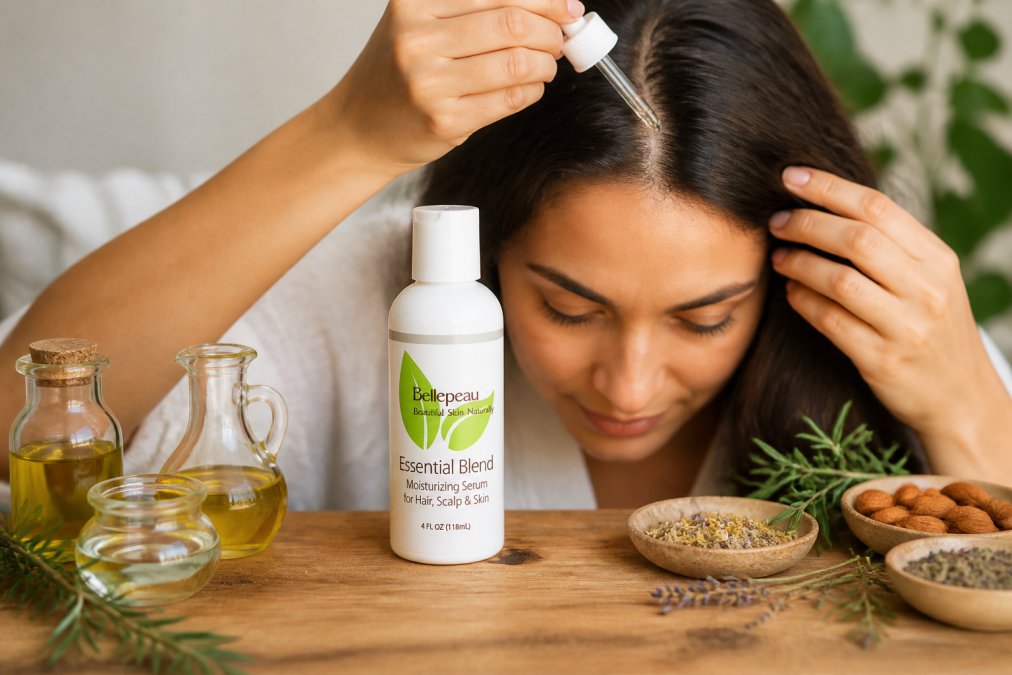
Ingredients that genuinely support sensitive scalp health include tea tree oil for its cleansing properties, lavender oil for its calming effect on irritated skin, and rosemary oil for supporting scalp circulation and hair follicle stimulation. Cold-pressed oils like olive oil provide nourishing fatty acids that help restore the scalp's lipid barrier without synthetic additives.
What to avoid entirely: synthetic fragrance, alcohol-based formulas, and any product with a long list of unrecognizable chemical names.
Bellepeau Essential Blend Serum: Plant-Based Relief for Stressed Scalps
The Bellepeau Essential Blend Serum ($24.00) is formulated specifically around the botanical ingredients most relevant to scalp health and eczema relief. The full ingredient list is short and transparent: organic olive oil, vitamin E, organic tea tree oil, organic lavender oil, organic rosemary oil, organic bergamot oil, and organic ylang-ylang oil.
There are no synthetic fragrances, no silicones, no parabens, and no fillers. Every ingredient serves a function. The olive oil provides deep moisture and conditions dry hair. The tea tree oil supports a clean, balanced scalp environment. The lavender and rosemary oils address both irritation and hair follicle health. Vitamin E acts as a natural antioxidant preservative and skin-conditioning agent.
Use it as a scalp treatment by parting hair and massaging a few drops directly into the scalp. For hair ends, apply sparingly to damp hair for moisture and shine. It also functions as a facial oil or body moisturizer.
Natural Hair Care by Hair Type: Matching the Right Ingredients
Hair porosity is the most useful framework for matching natural ingredients to your hair. High-porosity hair absorbs moisture quickly but loses it just as fast. Low-porosity hair resists moisture absorption but retains it well once it penetrates.
High-porosity hair (often chemically processed or heat-damaged): benefits from heavier cold-pressed oils like castor oil and argan oil that seal the hair shaft and slow moisture loss.
Low-porosity hair (tends to product buildup): responds better to lightweight oils like grapeseed oil and sweet almond oil that absorb without sitting on the surface.
Fine or thin hair: gravitates toward water-based serums and lightweight botanical extracts.
Coarse or textured hair: benefits from richer, more nourishing formulas like shea butter and avocado oil.
Cost-Per-Wash Analysis: Are Natural Products Worth the Price?
The sticker price of natural hair care products is almost always higher than conventional alternatives. The cost-per-wash calculation tells a different story.
A concentrated natural shampoo bar or high-quality serum requires far less product per use. The Bellepeau 3-in-1 Shampoo Bar ($18.00), a concentrated bar made with goat milk, vitamin E, and shea butter that replaces liquid shampoo, face wash, and beard wash simultaneously, competes directly with conventional liquid shampoos per wash, without the plastic bottle.
A plant-based serum like the Essential Blend at $24.00 covers hair, scalp, and skin in a single product. Replacing three separate conventional products with one natural multipurpose formula changes the cost comparison entirely.

Cruelty-Free, Vegan, and Sustainable Packaging: What the Labels Actually Mean
These three terms are not interchangeable.
Cruelty-free means the product and its ingredients were not tested on animals. The most recognized certification is from Leaping Bunny Program's cruelty-free standards, which requires auditing of the entire supply chain.
Vegan means the formula contains no animal-derived ingredients. A product can be cruelty-free but not vegan if it contains beeswax, lanolin, or keratin.
Sustainable packaging refers to the environmental impact of the container itself. Shampoo bars eliminate plastic bottles entirely, which is the most straightforward sustainability win in hair care. The Bellepeau 3-in-1 Shampoo Bar is eco-friendly and travel-ready by design.

A product that is all three, cruelty-free, vegan, and sustainably packaged, represents the most complete expression of eco-conscious natural hair care.
How to Verify a Product Is Truly Natural Before You Buy
The term "natural" has no legal definition in cosmetics under current FDA guidelines. Verification requires looking past the front label.
Here is a practical checklist for verifying a natural hair care product before purchasing:
- Check the full ingredient list, not just the highlighted ingredients on the front panel
- Cross-reference the top five ingredients on the EWG Skin Deep database for safety ratings
- Confirm the absence of synthetic fragrance, parabens, sulfates, and silicones
- Look for third-party certifications: USDA Organic, Leaping Bunny, EWG Verified, or NSF/ANSI 305
- Verify whether the brand discloses its full ingredient list online
- Check whether the brand's founder or formulator has verifiable credentials in cosmetology or dermatology
Bellepeau publishes its full ingredient lists for every product. The Essential Blend Serum's ingredient list is seven items long, all organic and botanically derived. That level of transparency is the clearest signal that a brand is not hiding behind vague natural claims.
Pro TipWhen evaluating any natural hair care product for the first time, do a 48-hour patch test on the inner wrist before applying to the scalp. Even genuinely natural formulas can trigger reactions in people with specific botanical allergies, particularly to essential oils like lavender or tea tree.
Watch OutAvoid products that list "fragrance" or "parfum" without specifying the source. This single ingredient can contain dozens of undisclosed synthetic chemicals and is one of the most common triggers for contact dermatitis on the scalp and skin.
Key TakeawayThe most reliable indicator of a genuinely natural hair care product is a short, fully disclosed ingredient list where every item is recognizably plant-derived or naturally occurring. Certification helps, but transparency is the real standard.
Switching to natural hair care products is straightforward once you know what to look for and what to ignore. The adjustment period is real, the ingredient verification process is learnable, and the long-term benefits for scalp health, moisture retention, and skin comfort are well worth the transition. Bellepeau was founded by a licensed cosmetologist with over 40 years of experience specifically to address what conventional formulas get wrong for people with sensitive, eczema-prone, or damaged skin. The Essential Blend Serum and 3-in-1 Shampoo Bar are a practical starting point for anyone building a clean routine from scratch. Shop Bellepeau and find the formula that fits your hair type and scalp needs.
Frequently Asked Questions
How do I know if a hair care product is truly natural?
Check the ingredient list, not the front label. Words like 'natural' and 'clean' are not regulated by the FDA for cosmetics, so any brand can use them freely. Look for recognizable plant-based ingredients — organic oils, botanical extracts, essential oils — near the top of the list. Avoid products where synthetic fragrance, parabens, or sulfates appear early. Third-party certifications like USDA Organic or cruelty-free seals from recognized bodies add an extra layer of verification.
What are the most important ingredients to avoid in natural hair care?
Sulfates (especially sodium lauryl sulfate) strip natural oils and disrupt the scalp microbiome. Parabens are synthetic preservatives linked to hormone disruption concerns. Synthetic fragrance is a catch-all term that can hide hundreds of undisclosed chemicals, many of which irritate sensitive scalps. Silicones create a coating that blocks moisture over time. For eczema-prone or sensitive scalps, also avoid synthetic dyes and formaldehyde-releasing preservatives, which commonly trigger flare-ups.
How long does the transition to natural hair products take?
Most people experience an adjustment period of two to four weeks. During this time, hair may feel heavier or greasier than usual as the scalp recalibrates its oil production after years of harsh cleansers. Washing slightly less frequently during this period helps. Scalp treatments with plant-based oils — like rosemary or tea tree — can support a balanced scalp environment while your hair adjusts. Sticking through the transition is worth it; most people notice improved texture and moisture retention by week four.
What is the best natural hair care option for eczema on the scalp?
Look for sulfate-free, paraben-free, and fragrance-free formulas with soothing botanicals like lavender, chamomile, or tea tree oil. These ingredients support scalp health without triggering irritation. The Bellepeau Essential Blend Serum ($24) combines organic olive oil, lavender, tea tree, and rosemary oils in a lightweight formula designed for dry, irritated scalps. It works as a leave-in scalp treatment and is formulated by a licensed cosmetologist with over 40 years of experience working with sensitive skin.
This article was written using GrandRanker
